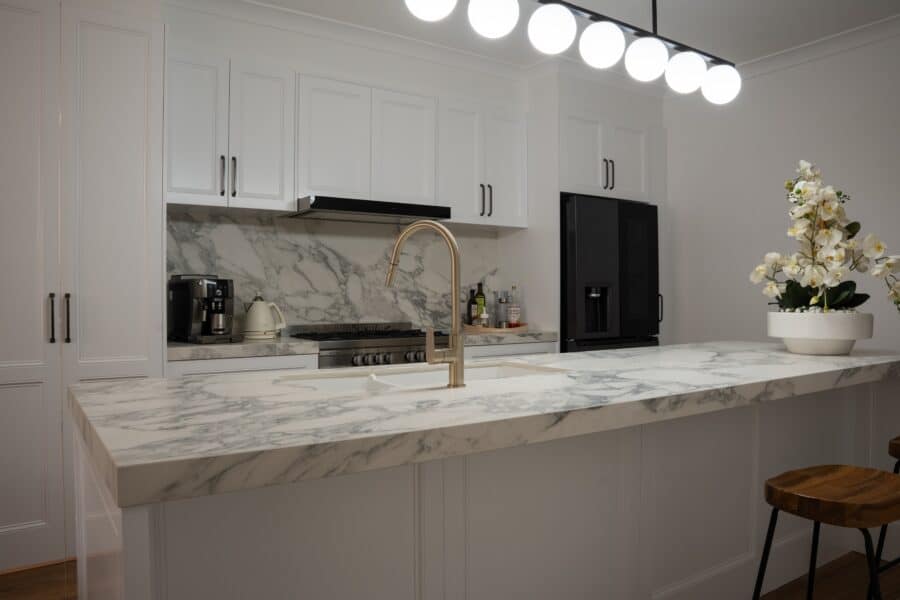
Most Melbourne homeowners begin with a number in mind and little sense of what sits behind it. Setting a kitchen renovation budget is easier once you know which decisions move the figure.
A custom kitchen at The Kitchen Design Centre starts at around $45,000. From there, kitchen renovation prices rise with the size of your space and the finishes you choose. TKDC has been building kitchens for Melbourne homes since 1994, so the guidance below reflects what actually shapes your cost.
What makes a kitchen renovation budget realistic?
A realistic kitchen renovation budget starts with the scope of work. Decide what is changing in your kitchen, then review the costs involved. Many homeowners begin with a figure in mind and work backwards, which is where budgets can come unstuck. Michael Simpson and Peter Schelfhout, both registered builders, have over 60 years of combined experience costing Melbourne kitchens.
Older homes can hide issues behind cabinetry and under floors. As a result, unexpected costs may arise if these conditions become apparent during a kitchen reno.
Your budget level and the kitchen it builds
Every kitchen we build is fully custom. That rules out a kitchen makeover that keeps your existing cabinetry. It also rules out a flat pack kitchen, where sizes are fixed.
What your budget changes is the selections inside that build. Start with cabinet doors, because they take up the most visible surface.
Melamine sits at the accessible end and wears well in a busy home. A mid-range kitchen renovation usually adds drawers in place of cupboards, along with deeper internal storage.
Cabinet handles, hinges and runners step up at the same time. Premium materials change how the whole room feels, though that difference is hard to judge on a screen. Our three Melbourne showrooms are where that becomes obvious.
Factors that move your kitchen cost
The size of your kitchen sets the baseline, and everything after that comes down to how much you change and what goes into the space. Because TKDC designs, manufactures and installs, these factors are priced once rather than renegotiated between separate trades.
Most of the variation traces back to six decisions:
- Kitchen size – A bigger kitchen means more cabinetry and more time on site.
- Layout changes – Moving a sink or an oven brings a plumber back to reroute services, then an electrician follows.
- Electrical work – Older switchboards often lack capacity, so electrical work can extend beyond the kitchen itself.
- Structural changes – Taking out a wall brings a carpenter into the schedule and adds engineering.
- Splashback choice – Ceramic tiles can keep a tiled splashback at the lower end and require a tiler for installation. A glass splashback usually costs more and must be fitted by a specialist glass installer.
- Appliances – Appliances vary more than anything else here, and cooktops and rangehoods sit at opposite ends of that range.
What is the most expensive part of a kitchen renovation?
Cabinetry is the most expensive part of a kitchen renovation. At TKDC, it accounts for roughly 30% to 40% of a project.
Custom cabinetry is priced by linear metre, so a longer run costs more before a single finish is chosen. Custom joinery for a pantry or an island adds to that.
The rest is labour. Every cabinet is built to your measurements by a qualified cabinet maker in our Bayswater factory, then tested for fit before it leaves.
Comparing benchtop materials and what they cost
Benchtops are one of the largest material costs in most kitchens, after cabinetry. Our range covers premium engineered stone, mineral and porcelain surfaces, as well as natural stone benchtops and laminate benchtops. These premium materials vary in price, appearance and maintenance.
- Premium engineered stone offers consistent colour and a practical surface for daily use. Brands such as Caesarstone and Quantum Quartz are two ranges our designers regularly work with. Our designers can talk you through the current products available and help you compare their finishes and performance.
- Mineral surfaces offer durability and low maintenance. Options such as ĒCLOS by Cosentino contain zero crystalline silica and provide heat resistance up to approximately 220°C. Dekton, also by Cosentino, is another ultra-compact surface worth comparing for busy kitchens.
- Porcelain resists heat, scratches and stains. It comes in a broad selection of finishes, including warm veining that pairs well with natural timber tones.
- Natural stone benchtops have individual colour and veining. However, they may require sealing and additional care.
- Laminate benchtops provide another practical option. Brands such as Laminex, Formica and Polytec offer modern finishes with improved resistance to scratches, suiting many family kitchens.
Each surface has its own benefits, so the right choice depends on how you use your kitchen. You can compare our range of stone benchtops, mineral surfaces and porcelain options during a showroom visit.
What should your kitchen renovation Project Costing include?
Your Project Costing should give you a cost breakdown by component rather than one figure at the bottom of the page. Without that detail, comparing two Project Costings fairly can be difficult.
Five things are worth hunting for before you sign anything:
- Cabinetry itemised by carcass, doors and hardware, so you can see where the money actually sits.
- Ask what “supply and install” covers, because the two are sometimes priced separately.
- Tapware, the kitchen sink and appliance models should be named, not described as quality fittings.
- Provisional sums flag work that has not been fully scoped yet, and they move once it is.
- Exclusions matter as much as inclusions. Flooring, painting and plastering are the usual gaps.
We build for a number of Victoria’s top-tier new home builders, and they will not sign off on an incomplete scope of works.
How TKDC prepares your Project Costing
Your Project Costing is built in four stages.
- Showroom Tour – Our Showroom Assistants guide you through the displays, materials and cabinetry, and explain how we work. Expect entry-level costing guidance at this stage rather than a detailed figure.
- Project Consultation – A designer visits your home to measure the space and work through layout, storage and the full scope of your project.
- Selections – Finishes, hardware and appliances are confirmed, because a costing cannot be accurate until they are.
- Project Costing – We build your costing from the measured scope and your confirmed selections. Once you approve the Project Costing, we prepare your contract. After you sign and return it, your dedicated Client Manager becomes your single point of contact for check measure, manufacture and installation.
Visit our Essendon, Blackburn or Eltham showroom to see and test the cabinetry before committing to anything. When you are ready for measured advice, book a Project Consultation with one of our designers.
FAQs
Is there a rule for how much to spend on a kitchen?
Property advisers often suggest spending 2 to 5 per cent of your home’s value on a kitchen. The Kitchen Design Centre treats that as a starting reference, since the right figure depends on how long you plan to stay.
Why does custom cabinetry cost more than flat pack?
Custom cabinetry is built to your exact measurements, so there are no filler panels where flat-pack cabinets would need them. The Kitchen Design Centre specifies Häfele Grass drawer systems as standard, and that hardware carries a different cost to entry-level runners.
Do older Melbourne homes cost more to renovate?
Often they do, because walls in older Melbourne homes are rarely square and services may not meet current standards. The Kitchen Design Centre recommends asbestos testing before demolition in homes built before 1990, common across established suburbs.
Why can two Project Costings for the same kitchen differ?
Scope explains most of the difference between two Project Costings. One may include trades, hardware or appliances that another leaves out entirely.
How long does a kitchen renovation take in Melbourne?
Duration depends on the size of the build, your finishes and whether structural work is involved. The Kitchen Design Centre builds your cabinetry before the old kitchen comes out, so you spend less time without a working kitchen.